Choking: What You Can Do to Help
 Download PDF
Download PDF
Choking: What You Can Do to Help
We are here to ensure you feel informed, comfortable, and supported throughout your journey. If you have any questions, please speak with your doctor or the medical team.
Every Second Counts — Know the Right Steps
Choking happens when an object, such as food, becomes stuck in the throat or airway, blocking the flow of air. In this situation, quick and calm action can save a life. This guide will help you recognise choking, respond safely, and know when to call for emergency help.
How to Recognise Choking
A person who is choking may:
- Have difficulty speaking, breathing, or coughing
- Make high-pitched sounds or no sound at all
- Clutch their throat (the universal sign for choking)
- Have blue lips or face
- Appear panicked or distressed.
If the person can still talk, cry, or cough forcefully, encourage them to keep coughing —
this may clear the blockage. If they cannot breathe, speak, or cough, act immediately.
What to Do: Adults and Children (Over 1 Year Old)
Step 1: Ask “Are you choking?”
If they nod or cannot speak, proceed quickly.
Step 2: Encourage them to cough if they can.
If the cough is weak or silent, continue to Step 3.
Step 3: Give up to 5 back blows.
- Stand slightly behind and to the side of the person.
- Support their chest with one hand.
- Lean them forward so the object can come out easily.
- With the heel of your other hand, give up to five firm blows between the shoulder blades.
After each blow, check if the object comes out.
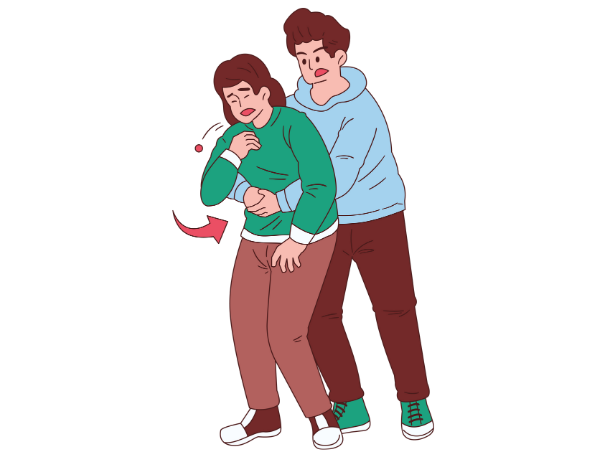
Step 4: If the blockage remains, give up to 5 abdominal thrusts.
- Stand behind the person and wrap your arms around their waist.
- Make a fist and place it just above their navel.
- Grasp your fist with your other hand and pull sharply inwards and upwards.
- Repeat up to five times.
Step 5: Alternate between 5 back blows and 5 abdominal thrusts until the object is
dislodged or help arrives.
If the person becomes unresponsive, call 911 immediately.
- Begin CPR (CardioPulmonary Resuscitation) if you are trained, starting with chest compressions.
- Continue until emergency help arrives.
What To Do for Babies (Under 1 Year Old)
Step 1: Sit down and hold the baby face down along your forearm, supporting the head and neck.
Step 2: Give up to 5 back blows between the shoulder blades with the heel of your hand.
Step 3: If the object doesn’t come out, turn the baby over (face up), resting them on your thigh.
Step 4: Give up to 5 chest thrusts using two fingers in the middle of the chest (just below the nipple line).
Step 5: Repeat 5 back blows and 5 chest thrusts until the object comes out or emergency help arrives.
Call 911 immediately if the baby becomes unresponsive.
Begin CPR if trained.
After the Choking Episode
Even if the person seems fine afterwards, seek medical attention, especially if:
- they experienced severe coughing or difficulty breathing
- abdominal thrusts were used (to check for internal injury), or
- the person is a baby, child, or older adult.
How to Help Prevent Choking
- Cut food into small pieces and chew slowly.
- Avoid talking or laughing while eating.
- Keep small objects, toys, and coins away from children.
- Supervise young children during meals.
- Avoid alcohol or sedatives when eating if they make you drowsy.
- Learn first aid — knowing what to do can save a life.
Frequently Asked Questions
Other Patient Pathway Posts
Pulmonary Embolism

What to Expect After a Head Injury

Recovering After A Concussion
How to Care for a Child Who Has Croup
Understanding Your Headache & When to Seek Help
Understanding Burns
Recognising the Red Flags of Cauda Equina Syndrome
Recovering After Cauda Equina Syndrome
Recovery From Back Pain
Pain Relief: Safe Use of Over-the-Counter Medications