Your Abdominoplasty Journey
 Download PDF
Download PDF
Your Abdominoplasty Journey
We want to ensure that you receive the highest level of healthcare. This means keeping you educated and informed about what is involved in the different stages of your Abdominoplasty procedure. If you have any questions or concerns, please speak with your surgeon or medical team.
Understanding Abdominoplasty
Abdominoplasty, commonly known as a Tummy Tuck, is a surgical procedure designed to remove excess skin and fat from the abdomen and tighten the abdominal muscles. It is often considered after:
- Major weight loss
- Pregnancy
- Age-related skin laxity
- Hernia repair (in some cases).
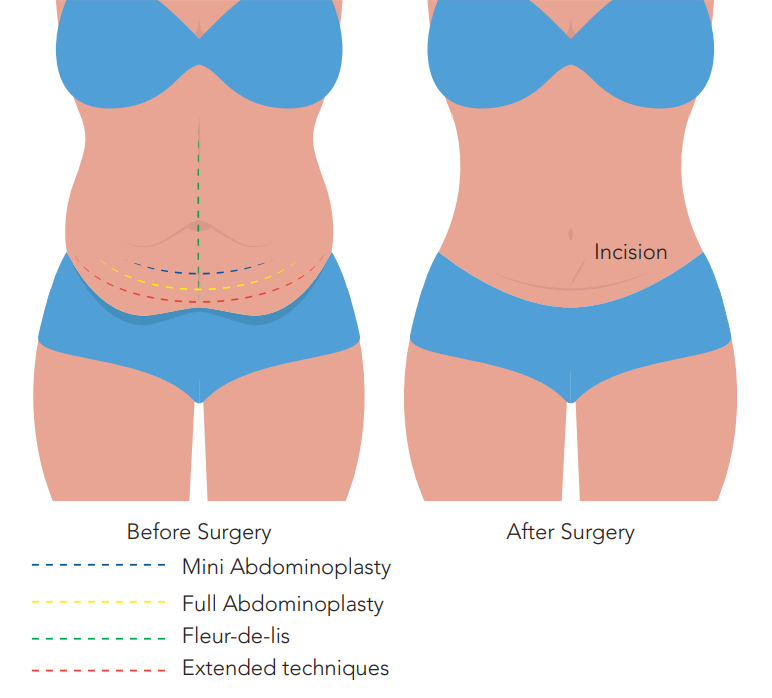
There are different types of Abdominoplasty, including:
- Full Abdominoplasty – removal of excess skin and fat with muscle tightening
- Mini Abdominoplasty – focused on the area below the navel
- Fleur-de-lis or extended techniques – for significant weight loss patients.

Why is it Done?
Abdominoplasty can help:
- Restore a firmer, flatter abdominal profile
- Address stretched or separated abdominal muscles (diastasis recti)
- Remove sagging skin that cannot be improved by exercise
- Boost body confidence and comfort.
It is not a substitute for weight loss or a treatment for obesity.
Preparing for Your Procedure
What to Tell Your Surgeon
Before your operation, be sure to inform your care team if:
- You have any chronic illnesses (e.g., diabetes, heart or lung conditions)
- You are taking blood thinners or supplements
- You are planning future pregnancies
- You’ve had previous abdominal surgery.
Pre-Procedure Instructions
Stop smoking at least 6 weeks before and after the procedure.
Do not eat or drink anything (except water) for 6–8 hours before surgery.
You may need to stop blood thinners or hormone therapy—check with your doctor.
You may need blood tests or a pre-operative assessment.
A consent form will be signed once the procedure is fully explained.
Arrange for someone to drive you home and stay with you for 24–48 hours.
Packing for the Hospital
Bring the following with you on the day:
- Comfortable, loose-fitting clothing (button-up tops preferred)
- Compression garment if instructed
- A list of medications and allergies
- Personal toiletries.
Leave valuables and jewellery at home.
The Day of the Procedure
On Arrival
- Check in at the surgical admissions unit.
- You’ll be assessed by a nurse and asked to change into a gown.
- An IV line will be placed for fluids and medications.
Before the Procedure
- You’ll meet your anaesthetist and surgical team.
- Your abdomen may be marked with a pen for surgical planning.
- You’ll be taken to the operating theatre under general anaesthesia.
What to Expect During Abdominoplasty
STEP 1: Anaesthesia and Preparation
- You’ll be placed under general anaesthesia.
- The surgical site will be cleaned and draped.
STEP 2: Incisions and Muscle Repair
- An incision is made along the lower abdomen.
- The surgeon may tighten underlying
abdominal muscles. - Excess skin and fat are removed.
STEP 3 Repositioning and Closure
- The navel may be repositioned.
- Skin is pulled tight and sutured in place.
- Drain tubes may be inserted to prevent
fluid build-up. - A compression garment will be applied.
Recovery After the Procedure
In the Recovery Room
- You’ll be closely monitored as you wake up.
- Pain and discomfort will be managed with medication.
- You may need to stay overnight or be discharged the same day (depending on the extent of surgery).
Caring for Yourself at Home: What to Expect
Rest with your upper body slightly elevated. Avoid standing fully upright.
Wear your compression garment as advised. Walk gently every few hours.
Limit strenuous activity. Avoid lifting anything heavy or driving.
Scars will continue to fade. Final results can take 6–12 months to settle.
When to Seek Medical Attention
Contact your surgeon or go to A&E if you notice:
- Heavy bleeding or increasing pain
- Redness, warmth, or pus from the wound
- Fever or chills
- Shortness of breath or chest pain
- Leg swelling or tenderness (risk of blood clots).
Follow-Up Appointments
After your operation:
- Your surgeon will review your healing progress.
- Stitches and drains may be removed in 1–2 weeks.
- Further follow-ups may be scheduled over
several months.
Frequently Asked Questions
Other Patient Pathway Posts
Pulmonary Embolism

What to Expect After a Head Injury

Recovering After A Concussion
How to Care for a Child Who Has Croup

Choking: What You Can Do to Help

Understanding Your Headache & When to Seek Help
Understanding Burns
Recognising the Red Flags of Cauda Equina Syndrome
Recovering After Cauda Equina Syndrome
Recovery From Back Pain