Your ACL Reconstruction Surgery Experience
 Download PDF
Download PDF
Your ACL Reconstruction Surgery Experience
We want to ensure that you receive the highest level of healthcare. This means keeping you educated and informed about what is involved in the different stages of your Anterior Cruciate Ligament Reconstruction Surgery. If you have any questions or concerns, please speak with your doctor or medical team.
Understanding Anterior Cruciate Ligament (ACL) Reconstruction Surgery
ACL Reconstruction Surgery is a very common operation, performed to replace a torn ligament in your knee. The ACL is a tight band of tissue inside your knee connecting the thighbone and the shinbone. Surgery is normally recommended when the patient is young, active and the ligament injury is complete. Initially RICE (Rest, Ice, Compression and Elevation), Nonsteroidal Anti-Inflammatory Drugs (NSAIDS), and physiotherapy are done until the knee is optimal for the procedure. The aim of the surgery is to provide a stable knee and give full range of motion so that patients can return to all activities that they used to do prior to the injury. ACL Reconstruction Surgery will usually take 45 minutes.
Types of ACL Grafts
In most adults, the ACL cannot be repaired and needs to be replaced/reconstructed by attaching (grafting) new tissue onto it. The surgeon will use a tendon called a graft, in place of the torn ACL. There are two common types of graft used.
- Autograft: The most common graft, which uses your own tendon from somewhere else in your body such as your knee, hamstring, or thigh tendon
- Allograft: uses sterilised tissue from a deceased donor
The type of graft used for each patient is determined on a case-by-case basis.
How to Prepare for Your ACL Reconstruction Surgery
Please note the following as you prepare for your upcoming surgery. Your doctor will advise you to:
- Have pre-operative blood tests and scans/X-rays; and
- Have a Pre-Anaesthetic Clinic (PAC) appointment with the anaesthetist, who will inform you when to stop eating and drinking and if any further investigations are needed before the procedure.
If you have diabetes, ask your doctor for instructions about when to take your insulin or other diabetes medication. You should also do the following.
- Take all other medications as usual with small sips of water on the morning of your procedure.
- Leave your jewellery and other valuables at home.
- Bring a current list of medications and allergies with you to the hospital.
- Bring your government-issued identification.
- Organise crutches for use after your surgery, as you are likely to need them. The hospital can help with this if needed.
- Ensure you have someone to drive you home after your procedure and to help you at home with everyday tasks such as cooking, bathing, and laundry.
The Procedure
These are the FOUR STEPS you will go through when you come to Health City for an ACL Reconstruction Surgery.
STEP 1
You will be admitted 60 minutes before your procedure unless otherwise advised by the patient care coordinator. After check-in, a healthcare provider will lead you to a room where you can change into a hospital gown. A nurse will check your vitals such as blood pressure, pulse, and oxygen, and place an IV line in your arm to begin delivering sedatives and pain medication to your bloodstream. From there, you will be taken inside the operating room for your procedure.
STEP 2
The anaesthetist will give you either a spinal block, which numbs the lower half of your body, or a general anaesthetic, which puts you into a sleep-like state. Your orthopaedic surgeon might also inject a numbing medicine around nerves or in and around the joint to help block pain after your surgery.
STEP 3
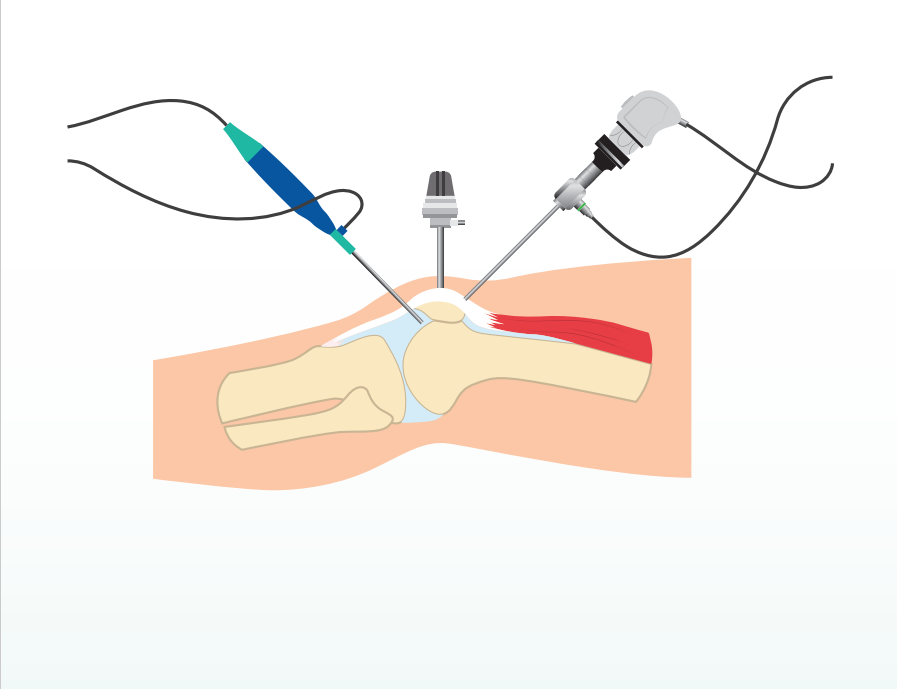
The surgical team will clean the skin on your knee and cover the rest of your leg with a surgical drape. They may place a clamp on your upper thigh to help with positioning during surgery. The surgeon will make a few small incisions, then fill the knee joint with a sterile fluid to help control minor bleeding in the joint, wash away debris, and help the surgeon see inside the joint. An arthroscope, a thin tube with a small light and video camera at the end, will be inserted into the incisions to look at the structures inside the knee. The images are projected onto a monitor. If the ACL needs to be replaced, the damaged ACL is removed. The graft (patients own or the cadaveric) will be shaped/looped on its own to create an ACL-like structure. The surgeon inserts the new graft/ACL into the femur and tibia using a flexible guide wire and fixes it with screws/titanium buttons. Once the reconstruction is completed, the surgeon will remove all surgical instruments, close the incisions with stitches or surgical strips, and then cover your knee with a bandage.
STEP 4
After surgery, you’ll rest in a recovery area for a short time before being taken back to your hospital room. You will likely be discharged the same day or the next day.
Your care team will need to ensure that all is stable before you are discharged by checking that:
- Your vital signs are within an acceptable range;
- Your pain is manageable, and you do not feel nauseous;
- You can get out of bed and stand up from a chair without assistance; and
- You can walk a short distance with an assistive device while wearing your brace.
Your Recovery Process – Uncomplicated ACL Reconstruction Surgery
You will go home with a brace on your knee to keep your knee stable, and be walking with crutches for two to three weeks. A physiotherapist will develop a recovery plan with you to improve your range of motion, stability and strength. This will likely take 3–6 months, but remember everyone’s journey is different, and returning to activities that you participated in prior to your ACL injury may take up to a year.
Timeline
Right after the surgery or next day, if you can tolerate it and with the help of a brace/cast and crutches
2 weeks
6 weeks if you can move with minimal or no pain and are not on opioid medication
6 weeks
6 - 12 weeks
4 months
6 months if your motion and strength are recovered and there is no swelling or pain in your knee
At-Home Care
You can expect some pain, swelling, and bruising after surgery. You should:
- Use ice packs or an ice therapy machine to reduce swelling and pain
- Take prescription pain relievers, such as opioids, as prescribed;
- Keep the affected leg facing forward and in front while standing or sitting; and
- Apply heat before exercise and cut back on exercise if the muscles begin to ache or there is swelling.
Follow-up Appointments
Your first dressing appointment will be three days post discharge then every three days. Your suture removal will be planned for 10-12 days post procedure. You will have an X-ray and a review with the doctor a month post procedure. All appointments will be made at your convenience and availability. If you need assistance between appointments, please contact us.
Frequently Asked Questions
Other Patient Pathway Posts
Pulmonary Embolism
What to Expect After a Head Injury

Recovering After A Concussion
How to Care for a Child Who Has Croup
Choking: What You Can Do to Help

Understanding Your Headache & When to Seek Help
Understanding Burns
Recognising the Red Flags of Cauda Equina Syndrome
Recovering After Cauda Equina Syndrome
Recovery From Back Pain