Your Gastrointestinal Bleed Scan Journey
 Download PDF
Download PDF
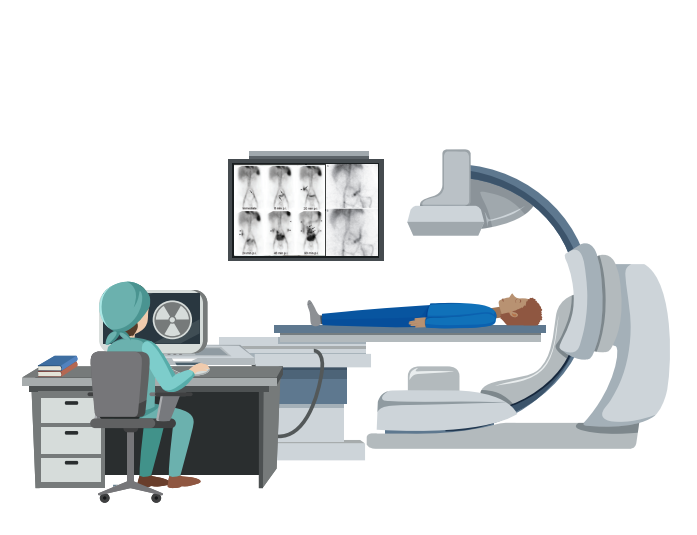
Your Gastrointestinal Bleed Scan Journey
We aim to ensure you feel informed, comfortable, and supported throughout the process. We are committed to providing the highest quality of care. If you have any questions, please speak with your doctor or the nuclear medicine team.
What is a GI Bleed Scan?
A GI Bleed Scan, also known as an in vivo labelled red blood cell (RBC) scan, is used to locate active bleeding in the digestive system. In this method, a harmless radioactive tracer (technetium-99m) is injected directly into your bloodstream through an intravenous (IV) line. The tracer attaches to your own red blood cells inside your body. A special gamma camera then tracks the flow of these labelled cells, helping to identify areas of internal bleeding.

Why This Scan May Be Needed
Your doctor may refer you for this Scan if you have:
- Unexplained or ongoing gastrointestinal bleeding
- Blood in the stool (bright red or black/tarry)
- Anaemia of unknown cause
- Suspected slow or intermittent bleeding in the digestive tract
- Previous scans or endoscopy without clear findings.
The Scan helps identify the source and rate of bleeding so that further treatment can be planned.
How to Prepare for Your Scan
Please follow these guidelines in preparation for the Scan:
- No special fasting is required unless instructed otherwise.
- Continue taking your medications, but bring a full list with you.
- Inform us if you:
- Are pregnant or breastfeeding
- Have a blood disorder or low platelet count
- Have had a recent blood transfusion.
You may want to arrange transport home, as the Test can take several hours.
What to Expect on the Day
STEP 1 Arrival and Check-In
Please arrive 15 minutes early and check in at the front desk. A member of our nuclear medicine team will meet you and escort you to the department.
STEP 2 Intravenous Injection
You will receive an injection of a safe radioactive tracer (technetium-99m) through a small IV line in your arm. The tracer will attach naturally to the red blood cells inside your body.
STEP 3 Imaging
- You will lie still on a scanning bed while a gamma camera takes images of your abdomen.
- Initial images are taken for about 1 hour, followed by delayed scans over several hours if necessary.
- You may be asked to return later in the day if the bleeding is intermittent.
STEP 4 After the Scan
- You may eat and drink as normal unless advised otherwise.
- Drink plenty of fluids to help flush the tracer from your system.
- The results are usually available within a few days and sent to your referring doctor.
Frequently Asked Questions
Other Patient Pathway Posts
Pulmonary Embolism

What to Expect After a Head Injury

Recovering After A Concussion

How to Care for a Child Who Has Croup

Choking: What You Can Do to Help

Understanding Your Headache & When to Seek Help
Understanding Burns
Recognising the Red Flags of Cauda Equina Syndrome
Recovering After Cauda Equina Syndrome
Recovery From Back Pain