Your Mammogram Experience
 Download PDF
Download PDF
Your Mammogram Experience
We want to ensure that you receive the highest level of healthcare. This means keeping you educated and informed about what is involved in the different stages of your diagnostic procedure. If you have any questions or concerns, please speak with your doctor or medical technician.
What is a Mammogram?
A Mammogram is an X-ray of the breasts. When a Mammogram is done, it creates a detailed image of the breast to show the size and shape of a lump or any changes in the breast.
Why is a Mammogram Performed?
Mammograms are done to diagnose or screen for diseases and conditions of the breast. There are two types of Mammograms:
- Screening: These are routine scans to detect breast cancer when there are no apparent symptoms.
- Diagnostic: Your doctor may order a diagnostic Mammogram after finding a lump; if you have breast pain, nipple discharge, or changes in breast shape or texture; if you have other signs and symptoms of a breast condition; or if you have dense breast tissue. Your doctor may also suggest a three-dimensional (3D) Mammogram which takes multiple X-rays from different angles and reconstructs them into a 3D view of the breast to give a better look for diagnosis of a condition.
What are the Risks of a Mammogram?
Our Health City Radiology Team follows strict standards for X-ray techniques and will use the lowest amount of radiation possible to produce the best Mammogram images. Your doctor will generally not order an X-ray if you are pregnant due to the danger of radiation to an unborn child. It is very important to tell your doctor if there is any chance of pregnancy.
Who will be involved in the Mammogram?
Your Mammogram will include the following team members.
- Radiology Technologist who will perform the Mammogram, and a
- Radiologist who will report on the Mammogram.
This is what you can expect when you come to Health City for a Mammogram.
Step 1
A member of the radiology team will escort you to the diagnostic wing.
Step 2
If you are pregnant or a female under 50 years of age, you will be asked to read and sign a consent form.
Step 3
You will be instructed to change into a patient gown. You may keep your trousers/skirt/shorts on if there is no metal on the waistband or elsewhere on the garment. You will be asked to remove any items that may contain metal.
- All jewelry (chest area)
- Eyeglasses
- Underwire bras
Step 4
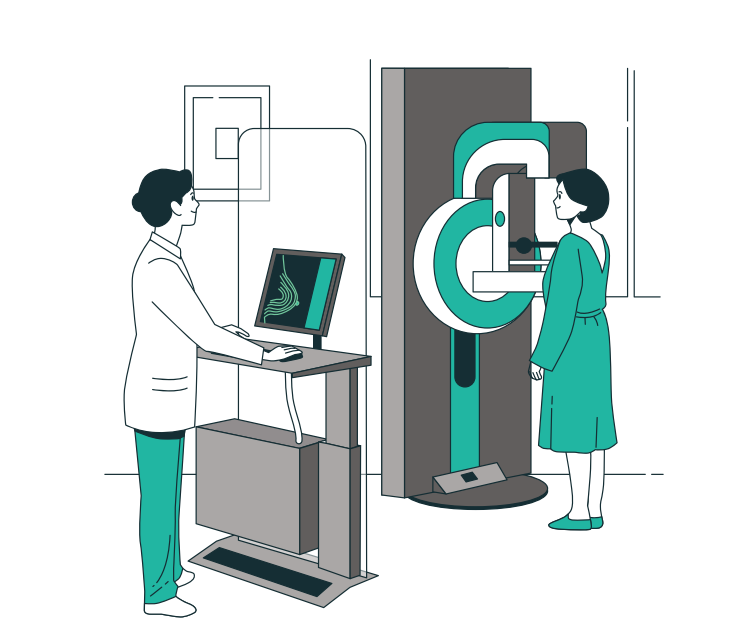
A member of the radiology team will escort you to the Mammogram Room, you will be standing up for your Mammogram. The radiology technologist will place one of your breasts at a time on an X-ray plate.
The Mammogram machine at Health City is 2D and 3D, which involves breast compression to get the clearest image possible.
The radiology technologist will stand behind a protective screen while they take images of your breast from different angles with the Mammogram machine. He or she may ask you to hold your breath during each picture. When the images are complete, the machine will release your breast from compression. The radiology technologist will repeat this process with your other breast.
Step 5
Once the exam is complete, you may get dressed. You may be asked to wait for a short time while the radiology technologist or radiologist verifies that the imaging is complete. The radiology technologist will stand behind a protective screen while they take images of your breast from different angles with the Mammogram machine. He or she may ask you to hold your breath during each picture. When the images are complete, the machine will release your breast from compression. The radiology technologist will repeat this process with your other breast.
Step 6
The radiology technologist will advise once verfication is complete and you may leave the department/hospital. Your Mammogram report will be sent to the ordering physician within 48 hours. Please ensure you have your follow-up appointment booked after.
Frequently Asked Questions
Other Patient Pathway Posts
Pulmonary Embolism

What to Expect After a Head Injury

Recovering After A Concussion

How to Care for a Child Who Has Croup

Choking: What You Can Do to Help

Understanding Your Headache & When to Seek Help
Understanding Burns
Recognising the Red Flags of Cauda Equina Syndrome
Recovering After Cauda Equina Syndrome
Recovery From Back Pain