Download Patient Guide


We are committed to providing the highest standard of healthcare. If you have any questions, please speak with your doctor or the neurophysiology team.
Nerve Conduction Study (NCS)
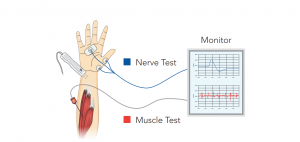
Nerve Conduction Studies (NCS) measure how fast and effectively your nerves transmit signals. This helps identify nerve damage or dysfunction in your peripheral nervous system (outside the brain and spinal cord). During the procedure, small electrodes are placed on the skin, and brief electrical impulses are delivered to the nerves. The resulting responses are recorded and analysed. NCS and EMG are often performed together for a full picture of muscle and nerve function.
Evoked Potential (EP) Studies
Evoked Potential (EP) studies assess how your brain and spinal cord respond to sensory stimuli, helping diagnose disorders that affect sensory pathways.
Types of EP Tests
1: Visual Evoked Potentials (VEP)
- Stimulus: Flashing lights or patterns
- Assesses: Optic nerve and visual pathway
- Used for: Multiple sclerosis, optic neuritis
2. Brainstem Auditory Evoked Potentials (BAEP/ABR)
- Stimulus: Clicking sounds or tones
- Assesses: Hearing nerve and brainstem
- Used for: Hearing loss, brainstem lesions
3. Somatosensory Evoked Potentials (SSEP)
- Stimulus: Electrical stimulation of nerves (e.g., wrist, ankle)
- Assesses: Nerves, spinal cord, and sensory cortex
- Used for: Spinal cord injuries, MS
Why These Tests May Be Needed
Your doctor may request one or more of these Tests to investigate:
-
1
Tingling, numbness, or burning sensations
-
2
Muscle weakness, cramping, or pain
-
3
Limb, neck, or back pain
-
4
Suspected nerve damage or muscle disorders.
-
5
These Tests can help diagnose:• Muscle disorders (e.g., muscular dystrophy)Per
-
6
ipheral nerve disorders (e.g. carpal tunnel, neuropathy)
-
7
Motor neuron diseases (e.g. ALS)
-
8
Nerve root issues (e.g. herniated disc, sciatica)
-
9
Sensory pathway problems (e.g. MS, optic neuritis).
How to Prepare for Your Test
Please follow these general guidelines to help ensure the best possible results:
- Avoid creams, lotions, or oils on test areas (hands, legs, scalp)
- Wear loose, comfortable clothing
- Bring a list of current medications
- Inform your doctor or technician if you:
- Take blood thinners
- Have a bleeding disorder
- Have a pacemaker or implantable device
- Have metal implants or skin conditions
What to Expect on the Day
Here’s what you can expect when you visit our hospital for a Neurophysiology Test.
STEP 1: Arrival and Check-In
Please arrive 15 minutes early and check in at reception.
STEP 2 : Briefing
The procedure will be explained, and you’ll have the chance to ask questions.
STEP 3 : Testing
EMG: A needle electrode will be inserted into the muscle. You may feel brief discomfort. NCS: Electrodes will be placed on the skin and mild electrical impulses applied. EP: Visual, sound, or nerve stimulation will be delivered, depending on the type of Test.
STEP 4: During the Test
You may be asked to change positions or contract specific muscles. Waveforms will be recorded and analysed on-screen. Most Tests take 30–90 minutes, depending on what’s being done.
STEP 5: After the Test
You can resume normal activities immediately. Mild soreness or tingling is rare but may occur. Results are sent to your referring doctor within 48 hours. Ensure a follow-up appointment has been scheduled.
Frequently Asked Questions
NCS may feel like a quick shock; EMG may cause brief discomfort from the needle. Most patients tolerate both well.
The Tests are safe and considered very low-risk. Possible mild bruising or temporary discomfort may occur at the Test site.
Tests can usually be performed with a pacemaker or implant. However, please notify us ahead of time.
There is no need for someone to drive you home, as you can drive and return to work or daily activities afterward.
These Tests do not cause permanent effects or changes.