Your Ultrasound Experience
 Download PDF
Download PDF
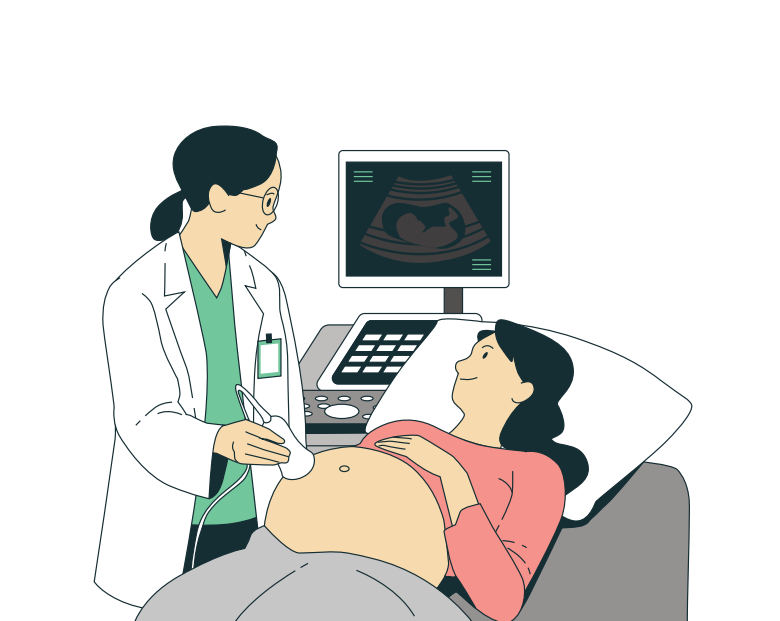
Your Ultrasound Experience
We want to ensure that you receive the highest level of healthcare. This means keeping you educated and informed about what is involved in the different stages of your diagnostic procedure. If you have any questions or concerns, please speak with your doctor or medical technician.
An Ultrasound uses high-frequency sound waves that bounce off structures like organs, blood vessels, and other soft tissues. A computer receives these signals and creates pictures of these structures.
Why is an Ultrasound Needed?
An Ultrasound may be needed to:
- Check on a developing fetus throughout pregnancy (one of the most common reasons)
- Check organs such as the liver, spleen, pancreas, gall bladder, kidneys, or bladder
- Diagnose abnormal bleeding, pain, menstrual problems, ovarian cysts, fibroids, kidney or bladder stones, and cancer in the uterus or ovaries
- Observe the prostate gland
- Screen patients for stenosis, which is a blockage or narrowing of the carotid artery.
This is what you can expect when you come to Health City for an Ultrasound Scan.
Step 1
Once you arrive at Health City, you will check in at reception.
Step 2
A member of the Health City team will escort you to the diagnostic wing.
Step 3
A radiology team member will then accompany you to the Ultrasound room. You might be asked to change into a patient gown depending on what area of your body will be scanned.
Step 4
Some Ultrasound Scans require a full bladder. Here are some examples:
- Pregnancy Ultrasounds in the first and second trimesters
- Renal Ultrasounds, or any ultrasound of the kidney,
ureters, or bladder.
In contrast, an empty bladder is necessary for Transvaginal Ultrasounds as a full bladder would obstruct the technologist’s view.
Ultrasound technologists also ask patients to avoid eating or drinking six hours prior to:
- Abdominal Ultrasounds,
- Inferior vena cava (IVC) Ultrasounds,
- Renal artery Ultrasounds.
Step 5
Abdominal Ultrasound: The healthcare provider will apply gel to your skin. The provider will gently move the handheld Ultrasound wand over your skin. You may need to change position until they get clear images on the screen. Once the scan is completed, you will be advised to wipe the remaining gel off your skin and to change out of the dressing gown, if applicable.
Bladder Ultrasound: The sonographer will ask you to use the restroom to empty your bladder midway through your Ultrasound appointment. Once you return, the sonographer will use the transducer to acquire more images of your bladder, measuring the post-void residual urine. If a urine test is also part of the appointment, it will happen after the Ultrasound Scan is completed.
Transvaginal Ultrasound: You will be required to empty your bladder beforehand. The technician/doctor will insert an Ultrasound probe, which they will cover with a condom and lubricating gel, about two or three inches into your vaginal canal. There may or may not be stirrups for you to put your feet in. You might feel some pressure as the transducer is inserted, similar to the pressure felt during a Pap smear. The technician or doctor then slowly turns the transducer to get a
comprehensive picture of your organs.
Non-Vascular Ultrasound: An Ultrasound of any extremities is a non–invasive diagnostic imaging test that uses high-frequency sound waves to create images of muscles, tendons, and bones in the arms or legs. This test is commonly used to evaluate soft tissue injuries or conditions such as sprains, strains, or tears, as well as to identify the presence of cysts, masses, or other abnormalities.
Step 6
Most Ultrasounds take approximately 30 – 45 minutes to complete. Your Ultrasound report will be sent to the ordering physician within 48 hours. Please ensure you have your follow-up appointment booked after. Once the imaging has been completed, the radiology team member will assist you off the couch.
You may change back into your clothes and exit the department/hospital.
Frequently Asked Questions
Other Patient Pathway Posts
Pulmonary Embolism
What to Expect After a Head Injury

Recovering After A Concussion
How to Care for a Child Who Has Croup

Choking: What You Can Do to Help

Understanding Your Headache & When to Seek Help
Understanding Burns
Recognising the Red Flags of Cauda Equina Syndrome
Recovering After Cauda Equina Syndrome
Recovery From Back Pain