Your X-ray Experience
 Download PDF
Download PDF
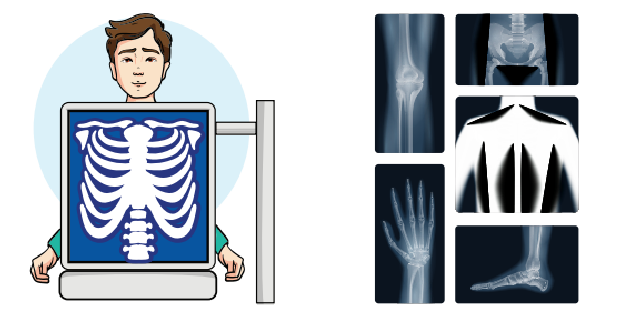
Your X-ray Experience
We want to ensure that you receive the highest level of healthcare. This means keeping you educated and informed about what is involved in the different stages of your diagnostic procedure. If you have any questions or concerns, please speak with your doctor or medical technician.
X-rays, the short version of X-radiation, are high-energy electromagnetic radiation beams that pass through your body producing images of structures, especially bones. X-rays are a quick, safe and effective way to evaluate your health.
Why is an X-ray Needed?
You may need an X-ray to:
- Help healthcare providers diagnose a wide range of injuries, disorders and diseases such as broken bones,
or structural issues in bones, joints, or soft tissues - Find the cause of pain, discomfort, or swelling
- Look for foreign objects in the body
- Monitor the progression of a diagnosed disease, such as osteoporosis, or the progression of treatment
- Complement routine screenings for diseases such as cancer and tuberculosis.
Types of X-rays
There are different types of X-rays. Some use contrast (dye) to make the images clearer to read.
Description
Scans the kidneys, stomach, liver and bladder
Identifies fractures, dislocated joints and arthritis, bone cancer, or infection
Looks at the spinal column (bones and tissues)
Identifies abnormalities in the heart, lungs and bones in the chest
Routinely carried out to evaluate teeth and gums, and to check for infection and cavities
-Shows moving images of organs and soft tissues (such as your intestines) -Includes procedures like barium swallow, barium meal, and barium enema. You may be admitted for this procedure.
An IV line is inserted in your hand or arm where the contrast (liquid) will flow into your vein to get images of the kidneys, ureters and urinary bladder.
You may be advised to fast, limit certain liquids, or clear out your bowels before coming in for your X-ray.
Who will be involved in the X-ray?
Your X-ray will involve a few team members. They include a:
- Radiology Technologist, who performs the X-ray, and
- Radiologist, who will report on the X-ray.
This is what you can expect when you come to Health City for an X-ray.
STEP 1
Once you arrive at the hospital/clinic, you will check in at reception.
STEP 2
A member of the Health City team will escort you to the diagnostic wing.
STEP 3
If you are pregnant or a female under 50 years of age, you will be asked to read and sign a consent form.
You may be instructed to change into a patient gown and remove any items that contain metal.
- Jewellery including watches and eyeglasses
- Hairpins/Barrettes containing metal
- Dentures and Hearing aids
- Underwire bras
Always tell the radiology team member if you have metal implants from prior surgeries.
STEP 4
The radiology team member will then accompany you to the X-ray room. Depending on the part of your body that requires an X-ray, you will be asked to stand or sit/lie down on the radiology couch. You may be asked to move your body or limbs into difference positions and to hold still. You might be required to hold your breath to ensure the images are not blurry. Stay still while the images are being taken, as this will provide the clearest images possible. Once the health provider is satisfied with the images gathered, your X-ray will be completed. In most cases, this will be approximately 5-15 minutes.
STEP 5
The radiology team member will assist you off the couch. You may change into your clothes.
STEP 6
You may now leave the reception area to exit the department/hospital. Your X-ray report will be sent to the ordering physician within 48 hours. Please ensure you have your follow-up appointment booked after.
Frequently Asked Questions
Other Patient Pathway Posts
Pulmonary Embolism

What to Expect After a Head Injury

Recovering After A Concussion

How to Care for a Child Who Has Croup

Choking: What You Can Do to Help

Understanding Your Headache & When to Seek Help
Understanding Burns
Recognising the Red Flags of Cauda Equina Syndrome
Recovering After Cauda Equina Syndrome
Recovery From Back Pain